Securing AI Agents: A Framework for Modern Workforce Management
As AI agents become essential team members, organizations must implement robust security frameworks to manage these non-human identities. This article explores a practical approach to ensure AI agents are onboarded, governed, and secured effectively.

In today's fast-paced digital environment, organizations are increasingly integrating Artificial Intelligence (AI) agents into their workflows. These agents are not just auxiliary tools; they are actively participating in critical business processes, from managing customer relations in platforms like Salesforce to automating IT tasks within Jira and provisioning infrastructure on cloud platforms. However, as these AI agents assume roles traditionally held by human employees, it becomes imperative for organizations to rethink their security frameworks. With non-human identities frequently outnumbering human users, the need for a structured approach to governance and security has never been more urgent.
JumpCloud's recent research reveals a striking statistic: 83% of organizations now have more non-human identities than human users, yet only 21% have established governance controls for these agents. This gap in governance not only exposes organizations to security risks but also hampers their ability to leverage AI effectively. In this article, we will explore a comprehensive framework designed to secure and govern AI agents within an organization, ensuring that every identity—human or otherwise—is accounted for and managed properly.

The Challenge of Shadow AI
The first step in addressing the security of AI agents is recognizing the challenge of Shadow AI. This term describes AI agents deployed by various teams—product development, operations, and individual contributors—often without formal oversight or a clear record of their purpose or actions. As organizations strive for agility, these unsanctioned deployments can lead to a chaotic environment where AI agents operate indiscriminately across production systems.
To tackle this issue, organizations must establish an accurate inventory of all AI agents currently operating in their environments. This inventory should encompass every platform where agents may be functioning, from cloud services and managed devices to on-premise systems. By documenting the access, workflows, and triggering conditions for each agent, organizations can lay the groundwork for effective governance.

Formal Registration of AI Agents
Once organizations have identified their AI agents, the next crucial step is formal registration. Each AI agent should be treated as a distinct identity within the organization’s directory, complete with a defined purpose, scope of actions, and a named human owner accountable for its behavior. This registration process is vital in transitioning from a reactive to a proactive governance model.
By registering AI agents as formal identities, organizations can assign entitlements, enforce conditional access policies, and include agents in regular access reviews. This structured approach also helps mitigate the risk of Zombie Agents—agents that continue to operate and access systems long after their initial purpose has expired. When every agent has an accountable owner, access permissions can be systematically revoked as ownership lapses, ensuring that outdated AI agents do not pose a security risk.

Implementing Least Privilege Access
Having established a formal registry of AI agents, organizations must manage their access with strict adherence to the principle of least privilege. This principle dictates that AI agents should only have access to the resources and data necessary to fulfill their defined duties. Access should be time-bounded where feasible and revocable at a moment's notice if an agent's behavior becomes suspicious or deviates from its intended purpose.
Another critical aspect of secure access management is avoiding the use of standing credentials. Static API keys and environment variables introduce persistent vulnerabilities that can be exploited. Instead, organizations should adopt practices such as issuing just-in-time credentials for privileged operations, implementing approval workflows that require human oversight, and ensuring that credential exposure is minimized through techniques like credential shielding. Recording every privileged session is essential for audit purposes, providing organizations with the necessary oversight to maintain security.
Continuous Governance and Behavior Monitoring
While establishing initial controls is crucial, the framework's effectiveness hinges on continuous governance. Organizations must verify that the actions performed by AI agents align with their authorized capabilities regularly. This involves logging every action taken by an agent and conducting periodic access reviews to ensure that entitlements remain appropriate.
Monitoring agent behavior for anomalies is vital to detecting potential security incidents before they escalate. When an agent's purpose changes or comes to an end, revocation of access should be an automatic procedural step rather than a response to a security breach. Effective governance ensures accountability by maintaining a comprehensive audit trail that answers critical questions: What did the agent access? What actions did it take? Who authorized those actions? Organizations lacking the ability to reconstruct this chain are not effectively managing their AI agents.

Building a Unified IT Environment
The success of the above framework largely depends on the organization's underlying IT environment. Disconnected systems for identity, access, device management, and security controls create gaps where governance can fail. JumpCloud's research indicates that organizations with unified IT environments are five times more likely to effectively deploy AI agents in critical workflows compared to those with fragmented infrastructures.
The concept of Agentic IAM—Identity and Access Management that encompasses humans, devices, and AI agents under a coherent control layer—is essential for scaling governance alongside AI adoption. By ensuring that every identity is known, governed, and accountable, organizations can significantly reduce risk and facilitate the responsible expansion of AI across their processes.
Key Takeaways
- Establish an inventory of all AI agents to mitigate Shadow AI risks.
- Register each AI agent with a defined purpose and a named human owner.
- Implement least privilege access and avoid standing credentials to enhance security.
- Continuously govern AI agents by monitoring behavior and conducting regular access reviews.
- Build a unified IT environment to support scalable governance for AI agents.
Frequently Asked Questions
What is Shadow AI, and why is it a concern?
Shadow AI refers to the deployment of AI agents without formal oversight or documentation, usually by individual team members who prioritize speed over governance. This can lead to security vulnerabilities, as these agents operate without proper accountability, potentially accessing sensitive systems or data without authorization.
How can organizations ensure AI agents are properly registered?
Organizations should develop a formal registration process for AI agents that includes defining their purpose, scope of actions, and assigning a named human owner responsible for their behavior. This process ensures that AI agents are treated like any other employee and are subject to governance controls.
What does least privilege access mean for AI agents?
Least privilege access means that AI agents should only have access to the resources necessary to perform their designated tasks. This minimizes the risk of unauthorized access to sensitive data and systems, as agents are not given excessive permissions that could be exploited.
How can organizations monitor AI agent behavior effectively?
Effective monitoring involves logging every action taken by AI agents, conducting regular access reviews, and employing anomaly detection systems that can flag deviations from expected behavior. This proactive approach helps organizations identify and address potential security incidents before they escalate into more serious issues.
Comments
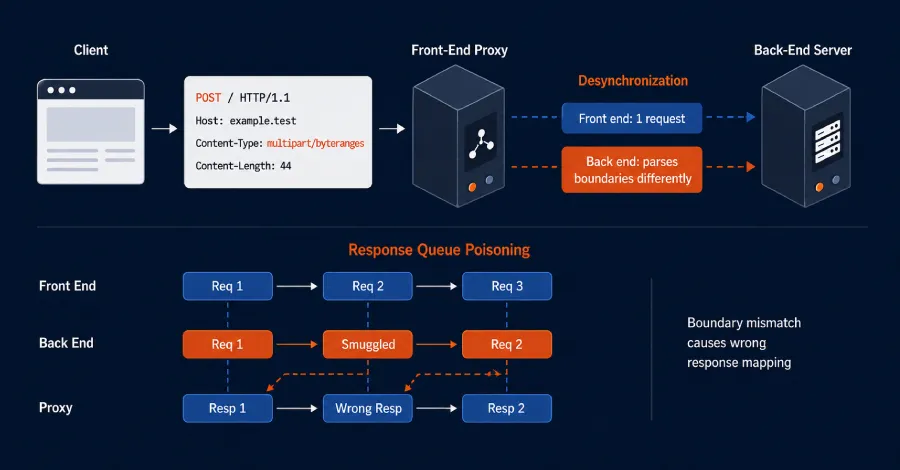
Exploring HTTP Desync Techniques and the Apache Zero-Day Threat
Recent developments in web security have unveiled alarming HTTP desynchronization techniques and a critical Apache vulnerability. This article delves into these issues and their implications for businesses.
Related articles




Popular in Cybersecurity
- Federal Mandate for Autonomous Vehicles: A Call for Safety Compliance
- EU Mandates Google to Share Data and Open AI on Android: What It Means
- GitHub Revamps Bug Bounty Program: Implications for Developers and Security
- Australian Government Disables Thousands of Functional Broadband Routers: A Wasteful Decision
- Exploiting Redis: Understanding Zero-Day Vulnerabilities and Their Mitigation