Volkswagen's Restructuring Plans Face Union Opposition Amid Job Cuts
Volkswagen Group is under pressure to restructure amid declining profits and market share. While the company outlines plans for fewer models, unions are rallying against potential job cuts and factory closures.
The automotive landscape is rapidly evolving, and Volkswagen Group finds itself at a critical juncture, grappling with challenges that could reshape its workforce and operations. As the world's automotive market pivots towards electric vehicles (EVs), Volkswagen has made strides in its home region, yet it struggles with costly tariffs and diminishing market share in pivotal territories like China and North America. These issues have led to a significant erosion of profit margins, prompting the company to reevaluate its strategy. However, this rethinking is not without contention, as evidenced by a recent clash between the company’s leadership and powerful labor unions.
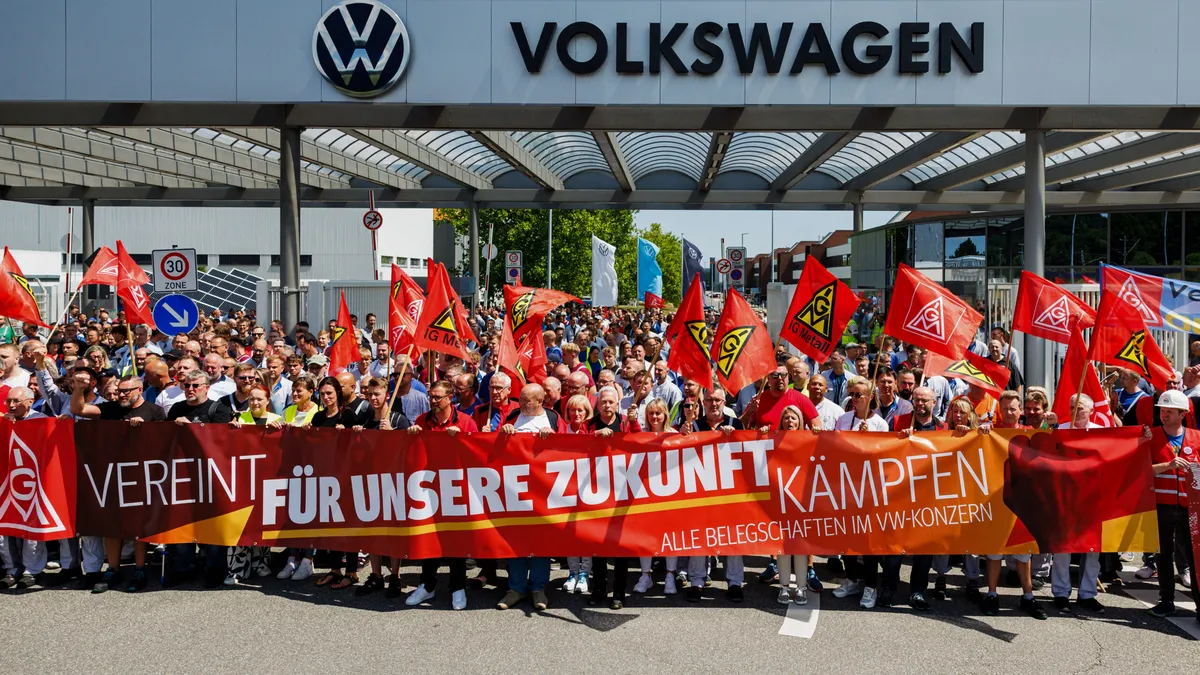
On July 9, 2026, employees of Volkswagen rallied in Zwickau, Germany, waving flags and banners that read, "To fight united for our future—all workforces across the VW Group." This demonstration, organized by the German trade union IG Metall, highlighted the deep-seated concerns among workers regarding potential job cuts and restructuring plans that could significantly alter the fabric of the company.
The Current State of Volkswagen: Struggles and Strategies
Volkswagen Group, which encompasses renowned brands such as Audi, Porsche, Skoda, and Lamborghini, is Europe’s largest automaker. Despite its success in the electric vehicle sector, the company faces multiple hurdles. The loss of market share in crucial markets and the imposition of tariffs have exacerbated its profitability issues. In response, VW's supervisory board was recently presented with a restructuring plan aimed at addressing these challenges and streamlining operations.
While the public announcement of the plan did not explicitly mention job cuts or factory closures, internal discussions revealed a different narrative. The supervisory board voted on the proposal, which ultimately failed at 12-7, indicating a significant divide between management’s vision and the workers' sentiments. Such a division is not uncommon at Volkswagen, where labor unions wield considerable power, holding half of the seats on the supervisory board.
The Role of Unions in Volkswagen's Structure
Volkswagen's unique governance structure grants substantial influence to worker councils. This means that any proposed changes affecting jobs or plant operations must navigate a complex landscape of union negotiations and employee rights. Historically, Volkswagen has witnessed fierce resistance from unions against any plans to cut jobs, and this current situation is no exception.
In 2024, after extensive negotiations, Volkswagen and its unions agreed on a plan to reduce the workforce by 35,000 jobs by 2030. However, as the company’s challenges deepened, the projected job losses escalated to 50,000 by March 2026 and have now reportedly reached an alarming 100,000, alongside the prospect of closing four plants in Germany—an unprecedented move for the company.

Restructuring Plans: Less Complexity, Fewer Models
Volkswagen's restructuring plan suggests a dramatic shift in its product lineup. The company plans to cut the number of models in half, focusing on the most lucrative market segments, which are increasingly dominated by crossovers and SUVs. This strategy aligns with consumer preferences in both Europe and the United States, where these vehicle types have gained significant traction.
Additionally, the plan emphasizes reducing complexity in manufacturing by cutting available equipment options by as much as 75%. This approach not only simplifies production processes but also aligns with Volkswagen's goal of matching its output with market demand. Currently, there is a mismatch between the company's capacity to produce 10 million vehicles annually and the actual demand of 9 million vehicles. Notably, Volkswagen has already reduced its output capacity by 2 million units since the COVID-19 pandemic, indicating a responsive, albeit reactive, strategy.
Market Dynamics: Demand vs. Capacity
The automotive market is undergoing seismic changes, with increasing competition from both established manufacturers and emerging electric vehicle startups. As a result, Volkswagen's decision to consolidate its model lineup reflects a broader industry trend towards streamlining operations to enhance profitability and efficiency. However, this strategy raises pressing questions about the future of the workforce.
- Impact on Employment: While the restructuring aims to position Volkswagen more favorably within the market, it raises concerns about significant job losses, impacting thousands of employees and their families.
- Union Resistance: The strong pushback from unions indicates that any proposed changes will face significant hurdles, potentially delaying or altering the restructuring process.
- Global Competition: With competitors aggressively pursuing electric vehicle sales and innovative technology, Volkswagen must act swiftly to avoid losing further market share.
The Road Ahead: Navigating Challenges and Opportunities
As Volkswagen navigates this tumultuous period, its leadership must balance the demands of profitability with the rights and concerns of its workforce. The absence of explicit mention of job losses or plant closures in public communications suggests a desire to maintain employee morale while addressing financial realities. However, this approach may be unsustainable in the long run if the company continues to face significant operational challenges.
Moreover, Volkswagen's commitment to electric vehicles is imperative, given the industry's trajectory towards sustainability and green technology. The company must not only streamline its operations but also invest in innovation to remain competitive in an increasingly crowded marketplace.
Strategic Recommendations for Volkswagen
To successfully navigate this transformation, Volkswagen could consider the following strategies:
- Transparent Communication: Maintaining open lines of communication with employees and unions is crucial to foster trust and mitigate resistance.
- Invest in Workforce Training: Offering retraining and upskilling programs for affected employees can help ease the transition and maintain workforce morale.
- Focus on Innovation: Continued investment in electric vehicle technology and alternative energy solutions is essential for long-term viability.
Key Takeaways
- Volkswagen Group is facing significant challenges with profitability and market share.
- The company's restructuring plan includes a reduction in the number of models and manufacturing complexity.
- Unions are strongly opposing potential job cuts and plant closures, highlighting the power dynamics within the company.
- Volkswagen must balance profitability with workforce concerns to navigate this turbulent period effectively.
Frequently Asked Questions
What is the main goal of Volkswagen's restructuring plan?
The primary goal of Volkswagen's restructuring plan is to improve profitability by reducing the number of vehicle models and simplifying manufacturing processes. This approach is intended to align production with market demand while addressing the company's declining profit margins and market share.
How are unions responding to the proposed changes?
Unions, particularly IG Metall, are strongly opposing the restructuring plans, especially concerning potential job cuts and factory closures. They argue that such measures could have devastating effects on workers and their families, and they are actively mobilizing employees to protest against these changes.
What impact will these changes have on Volkswagen's workforce?
The restructuring plan could lead to significant job losses, with projections indicating that up to 100,000 jobs may be cut by 2030. This prospect raises concerns not only about the immediate impact on employees but also about the long-term implications for the company’s labor relations and workforce morale.
How is Volkswagen positioning itself in the electric vehicle market?
Volkswagen is making strides in the electric vehicle market, capitalizing on its strengths in production and brand recognition. However, the company must continue to innovate and invest in electric vehicle technology to compete with emerging players in this rapidly evolving sector.
Comments
Impact of RFK Jr.'s Vaccine Policy on US Toddlers: An In-Depth Analysis
A recent study reveals alarming implications of Robert F. Kennedy Jr.'s changes to measles vaccination policies, particularly affecting vulnerable toddlers. This article delves into the details of the study, its findings, and what it means for public health.
Related articles


Popular in Guides
- Boomers Lead the Charge in Alcohol Abstinence: Insights from New Research
- Understanding the Physics of Silly Sprinklers and Feynman's Reverse Sprinkler Puzzle
- Hobbits of Flores: Scavengers or Skilled Hunters?
- The Coming Air-Conditioning Revolution in Europe: A Necessity or a Luxury?
- US Citizens Infected with Ebola: A Shifting Response Landscape