WD 1856 b: The Planet That Survived Its Star's Death
Discover the fascinating case of WD 1856 b, a Jupiter-sized planet that defied conventional astrophysical theories by surviving the demise of its Sun-like star. Recent findings reveal unexpected characteristics and raise questions about planetary evolution.
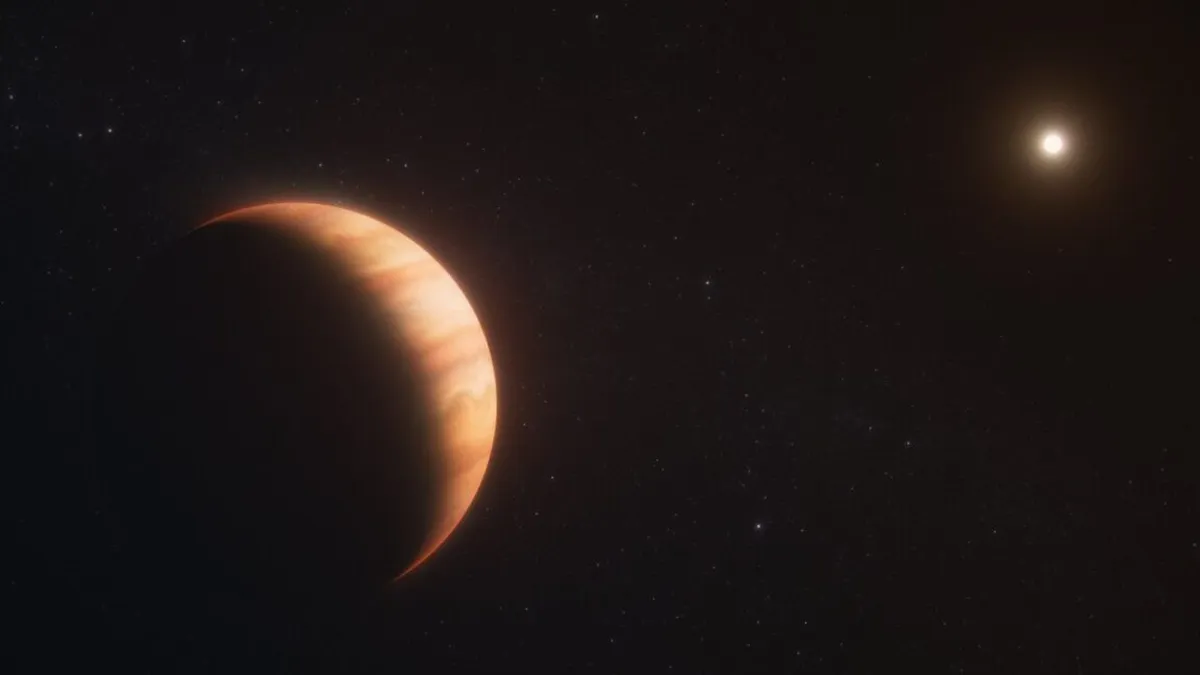
In the ever-expanding universe of astrophysics, the case of WD 1856 b stands out as a remarkable anomaly. This Jupiter-sized planet orbits a white dwarf—the remnant of a Sun-like star that has completed its life cycle. What makes WD 1856 b particularly intriguing is its survival during a celestial event that typically spells doom for nearby planets. As astronomers delve deeper into this peculiar system using the cutting-edge capabilities of the James Webb Space Telescope (JWST), they uncover a series of unexpected revelations that could reshape our understanding of planetary evolution.
Discovered accidentally by astronomers utilizing NASA's Transiting Exoplanet Survey Satellite (TESS), WD 1856 b challenges many astrophysical conventions. While most planets are thought to be consumed by their stars during the red giant phase, this gas giant not only survived but also appears to have moved closer to its star, defying predictions about how stellar death should influence planetary orbits. The implications of this discovery extend far beyond just one planet; they prompt a reevaluation of our theories regarding the lifecycle of planetary systems.
Understanding WD 1856 b's Unique Characteristics
WD 1856 b is unlike any other known exoplanet. It orbits its white dwarf host star at a shockingly close distance of about 0.02 astronomical units (AU)—a distance that places it perilously close to the remnants of a star that has shed its outer layers. This proximity raises questions about how the planet managed to avoid being engulfed during the star's transformation into a red giant, a phase that typically obliterates inner planets.
The Discovery Process
The initial discovery of WD 1856 b in 2020 was not the result of targeted research. Instead, the TESS team was conducting a survey of approximately 2,000 white dwarfs to identify smaller celestial bodies, such as asteroids or comets, transiting in front of these stars. To their surprise, they found a gas giant. The peculiar brightness patterns of the white dwarf star indicated that the planet was not merely passing directly in front of it but rather grazing its surface at an unusual angle, a phenomenon that left astronomers scratching their heads.
- Size Discrepancy: The white dwarf is about seven times smaller than WD 1856 b.
- Orbital Distance: WD 1856 b orbits at an incredibly close range of 0.02 AU.
- Brightness Dips: The brightness of the star dips by about 50%, suggesting a grazing transit rather than a direct one.

Examining the Atmosphere with JWST
To further investigate WD 1856 b, researchers utilized the advanced capabilities of the James Webb Space Telescope. Conducted on April 27, 2023, the observations captured a transit lasting just eight minutes. Given the unusual characteristics of the planet's orbit and size, the research team faced significant technical challenges in analyzing the data.
Innovative Techniques
Standard exoplanet transmission spectroscopy typically relies on the assumption that a smaller planet will completely obscure a much larger star when transiting. However, the grazing nature of WD 1856 b’s transit necessitated the development of new equations to interpret the observations accurately. The team adapted their software, POSEIDON, which is designed for reconstructing exoplanet atmospheres, to account for the unique geometry of the transit.
These observations revealed a surprising atmosphere for WD 1856 b, characterized by thick aerosol hazes and a significant methane content. It was also found to be emitting roughly 25 times more energy into space than it receives from its cooling host star, leading to temperatures around 400 Kelvin—much hotter than the anticipated range of 150 to 200 Kelvin typical for such a proximity to a white dwarf.

Decoding the Planet's Heat Source
The unexpectedly high temperature of WD 1856 b poses intriguing questions about its thermal dynamics. The planet's heat is unlikely to be a remnant of its formation; rather, it suggests some internal heating mechanism that has kept it glowing long after the demise of its star.
Two Competing Theories
The researchers proposed two potential scenarios for how WD 1856 b ended up in its current orbit. The first is the common-envelope model, where the planet was originally in a close orbit and managed to survive being engulfed by the expanding red giant star, emerging in a tight orbit around the remaining stellar core. The second scenario is the high-eccentricity migration model, which proposes that the planet started farther away and was gradually pulled inward through gravitational interactions with distant companion stars.
After analyzing the planet's thermal properties, the researchers concluded that the heat source likely stems from gravitational interactions with these companion stars, suggesting that the planet's current position is a result of a much more complex evolutionary history than initially thought.
Looking Ahead: The Search for More Survivors
The implications of WD 1856 b extend far beyond this single planet. Its proximity—only about 75 light-years from Earth—suggests that there may be many more survivor planets out there, waiting to be discovered. The team plans to conduct additional observations to gather more data, hoping to refine their models and search for other planets that have similarly defied the odds.
Future Investigations
Given the peculiar atmospheric composition of WD 1856 b, with a methane content significantly higher than the typical 0.3% found in Jupiter-like atmospheres, there is a compelling need for new models to accurately portray its evolution. These efforts could lead to groundbreaking insights into the nature of planets that survive the violent death of their stars and the complex interactions that govern their fates.
Key Takeaways
- WD 1856 b is a Jupiter-sized planet in a highly unusual orbit around a white dwarf.
- Its survival during the star's red giant phase challenges conventional astrophysical theories.
- The planet has an unexpectedly high temperature, indicating potential internal heating.
- Future research aims to discover more planets that have survived their stars' demise.
- The proximity of WD 1856 b makes it a prime candidate for further study.
Frequently Asked Questions
What is a white dwarf?
A white dwarf is the remnant of a star that has exhausted its nuclear fuel and shed its outer layers. It represents the final evolutionary stage of stars similar to our Sun. White dwarfs are incredibly dense and typically composed of carbon and oxygen, serving as a fascinating object of study in stellar evolution.
How does a planet survive the death of its star?
Typically, when a star enters its red giant phase, it expands and can engulf any nearby planets. However, in the case of WD 1856 b, it appears that the planet either survived this engulfment or migrated inward after the star shed its outer layers. This survival could be due to gravitational interactions with companion stars or unique orbital dynamics.
What is the significance of WD 1856 b's high temperature?
The high temperature of WD 1856 b, which is around 400 Kelvin, suggests that the planet has an internal heating source rather than simply re-radiating energy from its star. This finding opens new avenues for research into planetary atmospheric dynamics and the mechanisms that can generate heat within a planet after the death of its host star.
Are there more planets like WD 1856 b out there?
The discovery of WD 1856 b suggests that there could be many more planets that have survived their stars' deaths, particularly given its proximity to Earth. Ongoing and future observations will likely focus on identifying similar exoplanets, which could provide valuable insights into planetary evolution and the fate of solar systems.
Comments
The Future of Robotaxis: Navigating Partnerships, Policies, and Challenges
As the robotaxi market evolves, tensions rise between key players like Uber and Waymo while regulatory bodies demand improvements. This article explores the implications for the industry and consumers.

Related articles
Popular in Cloud Computing
- SK Hynix's Historic $26.5 Billion IPO: A New Era for Memory Chips
- Kubernetes and the Future of Desktop Infrastructure: A Paradigm Shift
- Amazon Expands Partnership with Nvidia, Tripling GPU Orders Amid AI Demand Surge
- Elon Musk's Evolving Relationship with Anthropic: A New Era for AI Hosting
- Emerging Rocket Launches: A New Era for Space Exploration